Click MeClick MeClick MeClick MeClick Me
Showing posts with label intrigue. Show all posts

Tuesday, May 17, 2016

Facebook’s operating chief opens up about her personal struggles after her husband’s death last year.


Original Article via

Sheryl Sandberg, Facebook Inc.’s chief operating officer, on Saturday opened up about her personal struggles since the death of her husband last year, in a commencement speech at University of California at Berkeley.
Her speech at Berkeley contrasted with the tone of her commencement speech at City Colleges of Chicago two years ago. That address focused on ambition, confidence and gender inequality, themes she hit on in her 2013 book “Lean In.”
It was the first time Ms. Sandberg spoke publicly about the aftermath of the passing last May of her husband Dave Goldberg, chief executive of online-questionnaire provider SurveyMonkey. Wavering between tears and laughter, and wearing a graduation gown in Berkeley’s blue and gold, Ms. Sandberg talked of the irony of finding gratitude through death, took a couple digs at Silicon Valley rivals, and revealed her New Year’s resolution.
Here are four excerpts from Ms. Sandberg’s speech at Berkeley:
Grief
Following the death of Mr. Goldberg, a psychologist friend of Ms. Sandberg suggested she think about how much worse things could be. It was counterintuitive: She said she had believed the way to recover was to try to find positive thoughts. He replied, “Dave could have had the same cardiac arrhythmia driving your children.”
Ms. Sandberg said she was overwhelmingly grateful that the rest of her family was alive and healthy. “That gratitude overtook some of the grief.”
Resilience
“The easy days ahead of you will be easy. It is the hard days—the times that challenge you to your very core—that will determine who you are,” Ms. Sandberg said. “You will be defined not just by what you achieve, but by how you survive.”
This year, Ms. Sandberg said her New Year’s resolution was to write down three moments of joy before going to bed each night. “This simple practice has changed my life. Because no matter what happens each day, I go to bed thinking of something cheerful. Try it.”
Working Life
In her first job, Ms. Sandberg said her boss found out she didn’t know how to enter data into Lotus software. She went home convinced she was to be fired. “I thought I was terrible at everything…but really I was just terrible at spreadsheets.” Understanding that her weakness was about one skill, not her entire professional potential, would have saved her a lot of anxiety that week, she said.
Ten days after she was widowed, Ms. Sandberg went back to work. “I remember sitting in my first Facebook meeting in a total haze, thinking, ’What is everyone talking about and how could this possibly matter?’” Ms. Sandberg related. “But then I got drawn into the conversation and for a second—the briefest of all seconds—I forgot about death.”
Humor
After Mr. Goldberg died, Ms. Sandberg’s rabbi told her time would heal, but for now she should “lean into the suck.” “Not what I meant when I said ’lean in,’” she joked.
Ms. Sandberg also made a friendly jab at Alphabet Inc.’s Google, a company that Facebook competes with for job candidates (and Ms. Sandberg’s former employer). “Everyone who has made it through Cal has already experienced some disappointment. You wanted an A but you got a B. OK, let’s be honest—you got an A-minus but you’re still mad. You applied for an internship at Facebook, but you only got one from Google.”

[H/T WSJ]

Wednesday, May 11, 2016

Japan’s Creepy Corpse Hotels Could Do Some Good in the States

japan-corpse-hotel


Original Article via
With 49% of Americans projected to choose cremation in 2017, we may need to address overcrowded crematoriums the same way Japan has. 
Dead people take up a lot of space, an issue Japan is beginning to comprehend. Approximately 110,000 people died in Tokyo in 2014, but there are only 26 operating crematoriums in the city. As the death rate continues to rise in Japan, the country has begun to explore alternative storage methods, if you will, to offer relief to overcrowded crematoriums. That solution comes in the form of “corpse hotels,” where bodies are stored in pristine conditions for up to four days before space is cleared at crematoriums for their arrival.
The new corpse hotel called Sousou is located in the city of Kanagawa, where 75,000 people died in 2014. As the city only has 20 operating crematoriums, it suffers from the same overcrowding issues as Tokyo. Located on a suburban block, the grim exterior of the hotel stands out among its surroundings with navy curtains covering all the window. The hotel may be slightly out of place, but it provides a place for families and friends to visit their loved ones before the body is shipped off to the crematorium a few days later.
Sousou representative Hisao Takegishi referred to the facility as a “funeral refugee,” a crucial step in dealing with the overcrowding issue at crematoriums. Sousou provides a section for relatives to relax and discuss their options with the staff, while the bodies of their loved ones are preserved in highly air conditioned other rooms in other parts of the building. The facility’s staff hopes to expand the business into other, more crowded cities like Tokyo where the disturbing nature of the building wouldn’t interfere in the lives of local residents as much.
Japan’s corpse hotel idea calls attention to a similar issue in the United States. Although interring bodies is still popular in America for religious reasons, according to data from 2014, the percentage of Americans who want to be cremated had risen from 3.5% percent in 1958 to nearly 40 percent, and there’s evidence to suggest that statistic will only increase. The number of crematoriums in the United States has increased to keep up with the trendiness of cremation, but it’s likely we may run into a similar problem like the one in Japan.
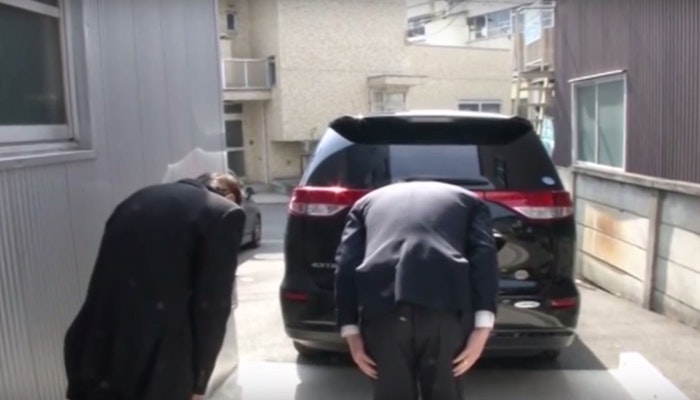
Members of the staff bowing as they say goodbye to one of their guests


Noting the projected 49 percent of Americans that will choose cremation in 2017, Barbara Kemmis, executive director of the Cremation Association of North America, said, “If we don’t address the capacity issue and increase the number of crematories, it could take up to two weeks to cremate someone in 2040.” Japan’s solution has secured a four-day waiting period between storage at the corpse hotel and cremation, putting the length of two weeks in perspective.
With the ever-increasing popularity of cremation in the United States, it looks like we may have to get dead serious about investing in some of these corpse hotels.
Photos via Youtube/Freeclick (123)
Cover Image: Reuters
[H/T: Inverse.com]

Wednesday, May 4, 2016

New Jersey Woman Honors Sister’s Memory With White Castle Urn

white_castle_urn


Original Article via

Stacey Parrinello, a woman from Manalapan, New Jersey, is paying tribute to her late sister Mel Burrows’ memory with a custom- made White Castle cremation urn, designed by Minnesota-based Foreverence, a company dedicated to celebrating the lives of loved ones with individually designed, 3-D printed, urns. Each as unique as the lives they represent.
Mel was diagnosed with terminal brain cancer in 2015, and as a special treat after her treatments, she and Stacey would sneak out of the hospital and pay a visit to their local Castle. “Let’s treat ourselves,” became the catch phrase of the sisters’ special trips and is prominently featured on the urn.
“It might seem a bit silly to some people, but White Castle provided a sense of normalcy during Mel’s treatments. And that was a true gift, because those days were difficult for all of us,” said Parrinello. “The time we spent together at White Castle is something I’ll always cherish and look back on fondly, because I loved that Mel was able to find such joy in one of life’s simple pleasures. The White Castle urn is a way I can honor her and cherish some of the last memories we shared together.”
To honor Mel’s memory and legacy, White Castle is inducting both Burrows and Parrinello into the 2016 Cravers Hall of Fame class. Bonded by unique and compelling commitments to the Crave, the Cravers Hall of Fame encourages White Castle’s most avid fans to submit original stories about their relationship with White Castle, and why White Castle is meaningful to them.
“We are humbled by Mel’s story, and truly honored that our small, two-by-two hamburgers were able to impact her life in such a positive way,” said Jamie Richardson, vice president of White Castle. “As a special gift from our family to hers, we are donating $10,000 to the American Cancer Society in her name. White Castle brought joy to Mel during some difficult times, and our mission is to share her story and give back to others on her behalf.”
Stacey will be invited to the 2016 Cravers Hall of Fame induction ceremony in October at the White Castle headquarters inColumbus, Ohio. The deadline for entering the 2016 contest is June 30, 2016. The judges set criteria to evaluate each story based on the following: brand loyalty, creative presentation, originality and magnitude of the Crave. Previous winning entries have included tattoos, epic road trips, moving family traditions that have spanned generations, tributes to fallen friends, two movie stars, the former Speaker of the U.S. House of Representatives and one rock legend.
Entries are submitted online at whitecastle.com/CHOF, where rules and regulations also are posted.
“Our mission is to honor and celebrate the lives of family members and friends in a unique and personalized way. We were touched by Mel’s story, and were more than happy to create a custom-made White Castle urn to memorialize the fond memories she had with her sister,” said Pete Saari, founder and CEO of Foreverence.
For those interested in learning more about the White Castle urns, a link is now available on White Castle’s online store.
For more information, visit www.whitecastle.com or www.foreverence.com.

Tuesday, April 26, 2016

A Guide to Getting Through Grief


As we all know, there is not one way to grieve. Not every person experiences it the same way, nor do they heal from it in the same way. The very idea of grief is surrounded by so many misconceptions, that it's hard to figure out what is normal and what's not. Many people have suggestions for how they deal/dealt with grief, but it's hard to figure out what works for you.

Happify Daily created an infographic that covers the basics of grief. They cover the myths such as "women suffer more in grief." They also talk about the early stages of grief, working through grief, and when grief is prolonged.

Take a look below or view the entire graphic HERE


Wednesday, April 20, 2016

The Man, The Myth & The Funeral Director: 5 Misconceptions

Article via

misunderstand in dictionary

Let’s face it. Most jobs have their fair share of over-generalizations and stereotypes. All cops love their doughnuts. Firefighters spend their time responding to calls about a cat in a tree—that is, when they aren’t busy cooking chili. I’m sure we’ve all heard a few lawyer jokes, too.

Most jobs are portrayed through stereotypes so often, it becomes second-nature to think about them that way (no matter how inaccurate those stereotypes might be).

What about funeral directors? Let’s take a look at some common misconceptions about the profession.

  1. Funeral directors = depressing Grim Reapers

Let’s start off with the most common misconception: Anyone willing to make a career revolving around death is morbidly obsessed with the dead right?
This is as unfair as accusing all police offers of pastry addiction. It has more to do with how we as a society, especially in America, view death. It is something of a taboo, and so it’s reflected in our ideas about funeral directors. Those who work with the dead get sucked into that mindset. That’s how we get that grim reaper image—that black suited, clammy handed, pale-man perception. Of course, this just isn’t true.

Funeral Directors are as normal as the rest of us, with perhaps a slightly grislier job than most. Their work is more noble than we tend to recognize. Their primary focus is on the family and helping them through one of the toughest points in their lives. They are caring and compassionate people.

  1. Don’t they spend their day just surrounded by bodies?

Does a firefighter spend all his time just putting out fires? As mentioned, funeral directors focus first and foremost on the families they serve. They do everything in their power to provide some degree of comfort and peace as these families mourn their loved ones. Funeral directors also spend a great deal of their time in their communities, serving as trusted leaders and resources. Otherwise, they might spend some time on the same tedious tasks as everyone else: preparation, planning, and paperwork—and even less time still in hospitals, cemeteries, and morgues.

  1. It’s all about the money

Most jobs share one universal trait: they allow someone to earn a living. If a sizable income was your goal, there are many other career paths that would be much less demanding. This isn’t a 9-5 gig. A death can occur at any time. This includes weekends and holidays. There is little flexibility for a funeral director on call. They have to drop everything to respond to a call, day or night. The work of a funeral director can be rewarding, but it can also be emotionally taxing and exhausting.

  1. The profession is a boy’s club

In the past, many family-owned funeral homes would pass the business from father to son. Lately, however, there has been a surge of women entering the profession. The American Board of Funeral Service Education (ABSFE) reported that in 2015, 56 % of graduates from accredited programs were female. Two generations ago, the estimate was zero percent. As these women make their way into the industry, they can help shatter the perceptions of a once male-dominated industry.

  1. Funeral directing is a recent thing

While a modern funeral might not resemble funerals of the past, death is nothing new. Humans have pretty much always practiced ceremonies to mourn their loved ones. Somebody has always been needed to help orchestrate such ceremonies. The job might not have looked the same 1,000 years ago, and it likely won’t look the same 1,000 years from now, but the job has always been (and will always be) profoundly meaningful and important.

It’s easy for people to fall into the trap and make unfair generalizations about funeral directors, but hopefully a little education and good information can aid in combatting these unfair stereotypes. The very nature of funeral directing—to help guide and assist families in a great time of need—is an inherently human thing. Funeral directors are emotionally invested and passionate about their profession.

Wednesday, April 6, 2016

Why January is the month you’re most likely to die: Factors like the chronic chill and genetics cause the year's highest death tolls

Article via:

What is it with deaths this January? Before we got halfway through the month, the world had lost a pantheon of cultural icons - musician David Bowie, actor Alan Rickman, and the DJ and Top Of The Pops presenter Ed ‘Stewpot’ Stewart.

These sad losses reflect a little known fact: that January is the peak time of the year for deaths. This is for a multitude of reasons - some quite straightforward, such as the cold weather, others more complex, such as our genes.

Quirks of the human psyche play a crucial part as well. January famously includes the ‘most depressing day of the year’ - the third Monday of the month - identified by Welsh psychologist Dr Cliff Arnall in 2005.

This was based on a formula said to weigh factors such as weather, debt, the time elapsed since Christmas and failed New Year’s resolutions. By applying a mathematical ‘sadness’ algorithm to these factors, yesterday was ‘Blue Monday’, as it’s come to be known.

Scientifically, this calculation may be bunkum, but the fact that so many are willing to believe it indicates the idea has strong emotional traction. Indeed, the Samaritans says that January is a peak time for calls from people feeling emotionally distressed and desperate.

Psychologists have a name for this potentially lethal post-festive plummet in morale: the ‘broken promise effect’.

People in low mood in the early winter hang on to the hope that Christmas and New Year will bring better things.

December sees a drop in the suicide rate, which experts call the ‘postponing effect’; the rate ‘rebounds’ in January, with an above average rise.

Another factor may be that people who are seriously ill often hang on to life at Christmas and New Year, for a final chance to see loved ones and enjoy the emotional warmth of the season.

Indeed, a study in 1973 by sociologists at the State University of New York found a similar peak in survival rates around people’s birthdays.

It also reported that seriously ill Jewish people may ‘postpone’ their deaths until after important religious dates such as Yom Kippur - the Day of Atonement.The report, published in the American Social Review, examined the death dates of more than 1,300 people. 

The cold weather, too, is an obvious factor - and last year proved to be particularly grim. In January 2015, the death rate peaked at more than 30 per cent above the average for that month over the previous ten years.

More than 12,500 more people passed away in those four weeks than usual. Public Health England (PHE) put it down to the weather, with the ‘statistically significant excess’ in deaths coinciding, it said, with serious cold snaps.

The sad fact is that Britain is comparatively very poor at protecting itself against the killer chill. 

Figures from the Office for National Statistics (ONS) reveal countries in Scandinavia and northern Europe that endure bitterly cold winters have lower excess winter mortality than Britain.

A 2013 ONS report noted that people in those countries take better precautions against the cold, and their homes are better insulated. 

Perhaps surprisingly, flu is not the great January killer. Most of the deaths are linked to respiratory and circulatory diseases brought on by the body being severely stressed by chronic chill.

As Tim Ellis, chief executive of the National Records of Scotland, explains: ‘Very few [of the additional deaths in winter] are caused by hypothermia and only a small proportion by influenza.

‘Most are from respiratory and circulatory diseases, such as pneumonia, coronary heart disease and stroke.’

There are also genetic reasons for such deaths.

In cold weather, our immune systems rev up to resist the bugs that thrive when people huddle together in stuffy rooms, shops, trains and buses. When our immune systems are highly active, they are also more likely to go awry.

But inflammation can be lethal. Chronic inflammation causes damage throughout the body and plays a significant role in heart disease, type 1 diabetes and arthritis.Our immune genes control our immune cells and trigger inflammation - the body’s way of fighting off infection by releasing chemicals that cause swelling as a defence against invaders.

‘We see a rise in new cases of type 1 diabetes in January,’ says John Todd, a professor of medical genetics at Cambridge University who studies seasonal gene changes. ‘Heart disease is also much worse in the winter months.’

Figures from the British Heart Foundation prove that there are significantly more deaths from coronary heart disease during January. Further- more, a 2012 study by Harvard university shows that levels of bad cholesterol and triglycerides (fats in the blood linked to heart disease) peak in January, and are lowest in summer.
The reason for this is not yet clear.

Once we have made it through January, though, we can all look forward to the happy months of July, August and September.

Across Britain, these have the lowest death rates, according to ONS figures between 1959 and 2012.
After that, the death rate begins to rise again in October, then begins a steep ascent to its winter heights at the start of November.

It seems that the English novelist Anthony Trollope had it right back in 1858, when he wrote in his novel, Dr Thorne: ‘Let no man boast himself that he has got through the perils of winter till at least the seventh of May.’

In the meantime, enjoy the rest of January. If you can.

Tuesday, March 29, 2016

Dead and Alive Project with Klaus Bo

Greenland 
In Upernavik, the soil is too hard to bury the dead. Instead, they are laid to rest in concrete and stone-covered coffins above ground. Often, these coffins face the ocean, so that dead sealers can watch the place they once worked. via

Photographer, Klaus Bo, has set forth a project documenting the different cultural experiences surrounding death. The project is called “Dead and Alive Project.”

In some places – like Denmark – death is taboo, in other places death and the deceased are natural parts of the life of the living. The background for this project is the desire to show how death rituals often reflect life. With its selection of different death and burial rituals, visitors to the final exhibition will gain insight into how much any given culture’s values, hopes and dreams are reflected in their thoughts about death and life after death, and how differently we treat our dead from culture to culture.”

Klaus has travelled far and wide to document different death traditions. Below are just a few of the photos that will be featured in the April issue of National Geographic with small insights to their stories:

Ghana
Church members carry Nene Nomo’s body to his grave. His coffin pays homage to his profession, chicken farming. via
Nepal
Ramri Tamang’s body is cremated on the outskirts of the village, surrounded by family members. According to their Buddhist beliefs, it is important to destroy the body so that the spirit cannot return to it. via
India
Bodies are cremated at Manikarnika Ghat, Varanasi’s main cremation grounds. More than 150 bodies are cremated there every day, and its frequent use has caused deforestation in the area. via

Madagascar
Family members dance with and celebrate their ancestor during a Famadihana. via

Haiti
Women in Port-au-Prince chant to lure the spirit of a deceased mambo, or Vodou priestess, into a kalabasa squash (seen floating in a bowl in the center). Afterward, they will release the spirit at a nearby road junction. via

To read more on the project, go to the project website HERE
To view the feature on National Geographic, click HERE

Wednesday, March 23, 2016

Decomposing Bodies Power Ethereal Cemetery Lanterns


What happens to you after death? We expect that our loved ones will grieve, someone will say consoling words to our family and friends, and perhaps there will be a party with fond toasts to our memory. But what becomes of our remains? In most cases, bodies are either embalmed or cremated, buried or scattered in some meaningful location. But the Centre for Death and Society at England’s University of Bath held a competition in hopes of reimagining the future cemetery. They selected as their winner ‘Sylvan Constellation,’ a proposal that combines grieving with the latest in green technology to create a sustainable, peaceful space.


Sylvan Constellation envisions the cemetery as a series of woodland paths through clusters of ‘memorial vessels,’ some at the level of the path and some suspended on columns overhead. The vessels contain remains and microbial fuel cells that hasten decomposition. As the body breaks down, its energy is converted into electricity that causes the vessel to glow, lighting the nearby paths, creating beautiful surroundings while avoiding the environmental impacts of embalming or cremation. Centre director Dr. John Troyer said in a press release, “The proposal captured the Future Cemetery design competition’s larger themes by presenting a mix of different sustainable technologies.”
The proposal is the work of Columbia University’s Graduate School of Architecture, Planning and Preservation. GSAPP will receive a prize of five thousand pounds and a month’s residency in Bath to research the nearby Arnos Vale Cemetery, where Sylvan Constellation will be constructed. GSAPP will collaborate with Arnos Vale and the Centre to bring the project to fruition. “By working together on this project, collaborators will establish networks for longer-term projects involving innovative, sustainable design around end-of-life planning,” said Troyer.
Original Article via

Wednesday, March 16, 2016

Irish Funeral Traditions: The Wake


The Irish are famous for many things like their St. Patrick’s Day celebrations, love of Guiness beer, and we can’t forget the accent! With St. Patrick’s Day just around the corner, we thought we’d explore Irish funeral traditions.

The Wake
A wake used to be a very lively event, and for some it still is. However, in recent years there has been a shift to making it a more somber event. In years past, the wake would be held in a house. The deceased would be laid down to rest, while stories were shared, laughs filled the air, and drinks were all around! The body is not to be left alone at any time. A person, usually a woman, sits nearby at all times.

Some traditions include stopping all the clocks in the house at the time of death. Some believe this is an effort to help the dead pass on, when they realize time isn’t passing. Others believe this was an effort to help the doctor know when to declare an exact time of death when he arrived.

Anther tradition includes turning all mirrors and pictures. It was said that a soul could get trapped in a reflective surface. Later they would haunt the home. While this may sound hokey, this stemmed from a time when there was an unhealthy interest in death. (Think Victorian era.)

Another common tradition at the wake would be to have every male caller take at least one puff from a pipe to lift evil spirits from the body. Some would place the pipe next to the deceased, even on their chests!

Want to read more about the Irish wake? Click HERE OR HERE


Monday, February 29, 2016

What Happens to Your Social Media Profiles After You Die?


Death during the 21st century is a tad more complicated than in the past with the introduction of the Internet, e-mail, and social media. In addition to funeral arrangements and financial arrangements, families of the deceased must now decide what to do with social media accounts!

So what happens to your social media profiles when you die? The answer to this question depends entirely on which social media platform you’re asking about.


Facebook: You have two options with Facebook. Immediate families, after showing proper documentation, can choose to close the entire account or turn their profile into a memorial page. Should you choose to go with the memorial page, Facebook will remove sensitive information from the profile (contact information and addresses), removes all status updates, and also changes the profile settings so that only friends can find the profile and post information to the memorial wall.

The profile will no long show up in the “People You May Know” section, nor will friends be reminded of the deceased’s birthday. Facebook will also deactivate the user’s login information to prevent anyone from guessing the user’s password and logging in.

If no notice is given, Facebook will leave the profile as-is forever.

Would you like to put in the request to deactivate a deceased person’s account or create a memorial page? Click HERE 

Twitter: After six months of inactivity, Twitter automatically starts deleting inactive accounts. Upon receiving proper documentation, Twitter will deactivate an account for a death notice. At no point in time will Twitter release the login information for a deceased person’s account, regardless of your relation.

Uniquely, Twitter will not recycle any username information. So, your username is yours to keep!

Would you like to put in the request to deactivate a deceased person’s account? Click HERE

Instagram: While Instagram won’t release any login information, they do give you options for the deceased’s account. Just like Facebook, you can choose to Memorialize the page or remove the account altogether.  They require certain documentation to support your claim, but an immediate family member can submit the form at any time.

Would you like to put in the request to remove a deceased person’s account or create a memorial page? Click HERE

LinkedIn: Your profile will remain live until notice is given. An immediate family member must submit the request along with documentation and additional information like the link to the obituary. After review, LinkedIn will close the account and remove the deceased’s profile.

Would you like to put in the request to close a deceased person’s account? Click HERE

Gmail: Did you know you can decide what you want done with your account before you die? Google calls it their “Inactive Account Manager.” You can decide who has access to your information ahead of time.

If this wasn’t set up, an immediate family member can submit a request to either close the account or request very specific information from the account. At no time will Google release login information.  Also, even after the account has been deactivated, Google does not re-release the username to be taken by someone else.

Would you like to set up your Inactive Account Manager or submit a request on behalf of a deceased person? Click HERE

Want to learn more? Read some of these great articles!

View: “What happens to all my social networking information when I die?” by Jonathan Strickland

View: “What Happens to Your Social Media Profiles When You Die?” by Sylvan Lane